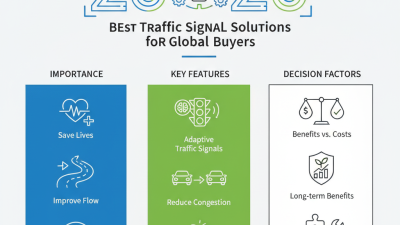
2026 Best Traffic Signal Solutions for Global Buyers?
In today's urban landscape, effective traffic management is vital. Traffic signal solutions play a crucial role in ensuring safety and efficiency on our roads. With the rapid advancement of technology, buyers face numerous options. This makes selecting the right traffic signal system a complex task.
Understanding the features and benefits of different traffic signal solutions is essential. Some systems offer real-time data analytics for improved traffic flow. Others incorporate smart technology to adapt to changing conditions. Despite the advancements, it can be overwhelming to choose the ideal system that fits specific needs.
Buyers must consider their unique contexts. Not all traffic signals are created equal. While some may focus on sustainability, others may prioritize cost-effectiveness. Thus, reflecting on these factors is key. A traffic signal solution must meet both current and future demands. The right choice can significantly impact urban mobility and safety.

Overview of Traffic Signal Solutions for Global Buyers
Modern traffic signal solutions are critical for improving road safety and traffic flow. An industry report forecasts the global traffic signals market will reach USD 3.8 billion by 2026, driven by urbanization and intelligent transportation systems. Advanced technologies, such as adaptive signaling and V2X communication, enhance responsiveness to real-time traffic conditions. Cities are investing to reduce congestion and enhance pedestrian safety.
When considering options, note that not all solutions deliver the same results. Systems must be tailored to local requirements. In some cases, outdated infrastructure hinders the effectiveness of new technologies. An approach focused on research and community feedback can lead to better implementations.
Tips for selection include evaluating scalability and compatibility with existing systems. Invest in training for stakeholders to maximize the technology's benefits. Regular maintenance is also vital; neglected systems can lead to increased accidents. Identifying potential gaps or failures early can help cities adapt swiftly.
2026 Best Traffic Signal Solutions for Global Buyers
| Solution Type |
Key Features |
Estimated Price (USD) |
Market Availability |
User Rating (out of 5) |
| Smart Traffic Lights |
Adaptive signal control, real-time traffic data analysis |
$15,000 |
Global |
4.8 |
| LED Traffic Signals |
Energy-efficient, varied color options |
$5,000 |
North America, Europe |
4.5 |
| Pedestrian Signals |
Countdown timers, audible signals for visually impaired |
$1,500 |
Global |
4.6 |
| Vehicle Detection Systems |
Infrared, microwave sensors |
$3,200 |
Asia, Europe |
4.7 |
| Traffic Management Software |
Centralized control, data analytics |
$25,000 |
Global |
4.9 |
Key Features to Consider in Traffic Signal Systems
When selecting traffic signal systems, key features are crucial for optimizing efficiency and safety. One major aspect is traffic adaptability. Modern systems should adjust signal timing based on real-time traffic flow. This prevents congestion and improves overall traffic management. Additionally, responsiveness to emergency vehicles is essential. Signals that prioritize emergency response can significantly reduce response times, enhancing public safety.
Another important feature is signal visibility. High-contrast signals and LED technology are necessary for ensuring all drivers see and understand the signals clearly. Regular maintenance checks are also vital. Neglected signals can lead to malfunctions, causing confusion at intersections. Integrating smart technologies can aid in monitoring and diagnosing issues proactively.
Moreover, user-friendliness cannot be overlooked. Both drivers and pedestrians should find signals intuitive. Incorporating features like countdown timers for pedestrians improves safety and helps manage pedestrian traffic more effectively. Yet, while these features offer many benefits, they can also lead to unintended consequences. For instance, too many features can overwhelm or confuse users, leading to potential dangers at busy intersections. Reflection on balance is key. Each feature must genuinely add value without complicating the user experience.
Top 2026 Traffic Signal Manufacturers and Their Offerings
In 2026, traffic signal solutions are evolving rapidly. Global cities are focusing on smart technology to manage traffic effectively. Reports indicate that smart traffic signal systems can reduce congestion by 30%. This shift highlights the need for manufacturers to provide adaptive signal control technology.
Manufacturers play a crucial role in integrating sensors and software. They enable real-time data analysis for better traffic management. More than 50% of cities plan to invest in upgraded traffic signal systems by 2026. These systems often include features like pedestrian detection and emergency vehicle prioritization. Despite the advancements, challenges remain, such as the high cost of installation and maintenance.
Many regions still rely on outdated infrastructure. The demand for interoperability among different systems increases. Traffic signal manufacturers must address this gap. Reports suggest that seamless integration could boost traffic efficiency by 20%. As urban areas continue to grow, the need for reliable and high-performing traffic solutions will be paramount.
2026 Best Traffic Signal Solutions for Global Buyers
Innovative Technologies Shaping Traffic Signal Solutions
Innovative technologies are transforming traffic signal solutions in ways that enhance efficiency and safety. One notable advancement is the integration of artificial intelligence. AI can analyze real-time traffic patterns, adjusting signal timing accordingly. This ensures smoother traffic flow and reduces congestion. Moreover, machine learning algorithms can learn from historical data, predicting peak traffic times and optimizing signals in anticipation.
Another area of innovation is the use of smart sensors. These devices can detect vehicle presence and pedestrian movements, providing instant feedback to the traffic control system. For instance, infrared and radar sensors can monitor traffic speed and volume. They help prevent accidents by triggering changes in signal patterns when necessary. However, reliance on technology raises questions about data privacy and security. Continuous improvements and assessments are crucial to maintain trust in these systems.
Cloud-based platforms are also making waves in traffic management. They enable centralized monitoring of signals from multiple locations. This allows for better coordination between various traffic signals. However, cloud solutions must be robust against cyber threats. The balance between convenience and security needs constant attention. As cities evolve, so do their traffic management needs. The journey to the ideal traffic signal solution is ongoing, demanding regular reflection and adaptation.
Global Trends Impacting Traffic Signal Systems in 2026
As we approach 2026, traffic signal systems are evolving rapidly. Key global trends are reshaping how these systems function. Urbanization continues to accelerate, leading to increased traffic congestion. Cities are rethinking their traffic management strategies to accommodate growing populations.
Smart traffic signals are becoming vital in this process. They adapt to real-time conditions, improving flow and reducing wait times.
Sustainability plays a crucial role in the development of traffic signals. With more cities committing to green initiatives, energy-efficient signals are on the rise. Innovations like solar-powered systems are gaining traction.
However, the challenge lies in ensuring affordability and accessibility for all communities. Not all locations can implement these cutting-edge technologies, raising questions about equity in traffic management.
Another trend is the integration of artificial intelligence. This technology analyzes traffic patterns and optimizes signal timing. While it offers significant benefits, it also comes with complexities. Data privacy concerns and the need for robust infrastructure cannot be overlooked.
Overall, while advancements promise to enhance traffic systems, ongoing scrutiny is essential to navigate the challenges ahead.