2026 How to Choose the Best Led Strobe Lights for Your Needs?
Choosing the right LED strobe lights can be a challenging endeavor. The market is saturated with options, making it difficult to identify the best fit for individual needs. According to a recent industry report, the global market for strobe lights is expected to grow significantly, surpassing $1 billion by 2025. This growth emphasizes the increasing demand for effective lighting solutions across various sectors, such as emergency services, construction, and entertainment.
LED strobe lights have become a popular choice due to their energy efficiency and bright illumination. Many users may overlook critical features when selecting LED strobe lights. For instance, understanding the lumen output and the strobe frequency is crucial for effective visibility. Some reports indicate that a proper choice can enhance safety in emergency situations. However, not all products perform equally, which adds complexity to the decision-making process.
Purchasing LED strobe lights often involves identifying specific requirements. Consideration of the environment and intended usage can lead to better outcomes. Ignoring these factors might result in inadequate performance. Lighting experts suggest that investing time in thorough research helps avoid mistakes. Capturing the right combination of brightness, durability, and features is essential for getting the best value.
Understanding the Basics of LED Strobe Lights and Their Functions
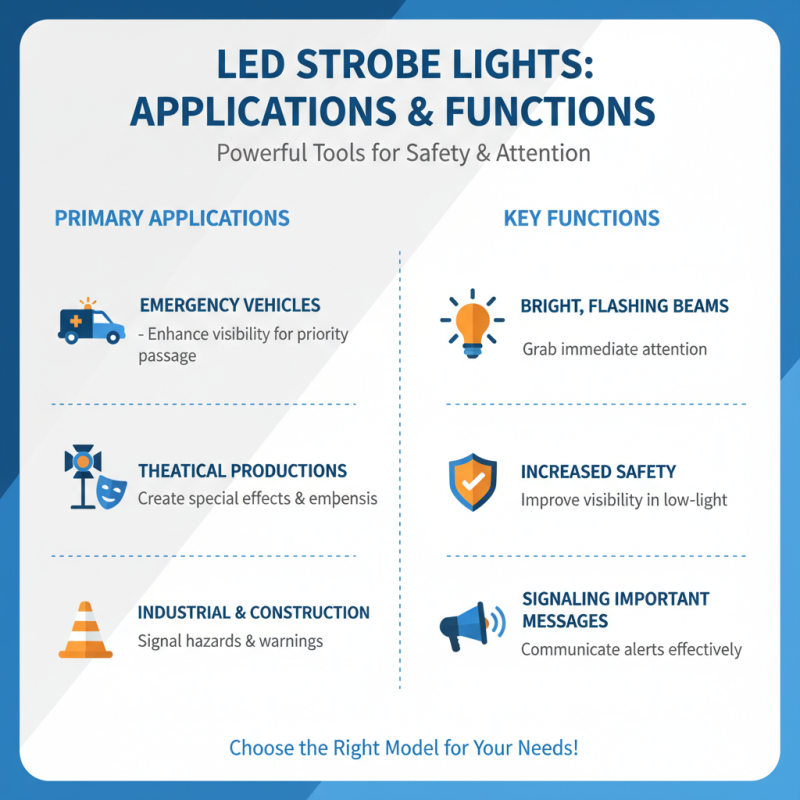
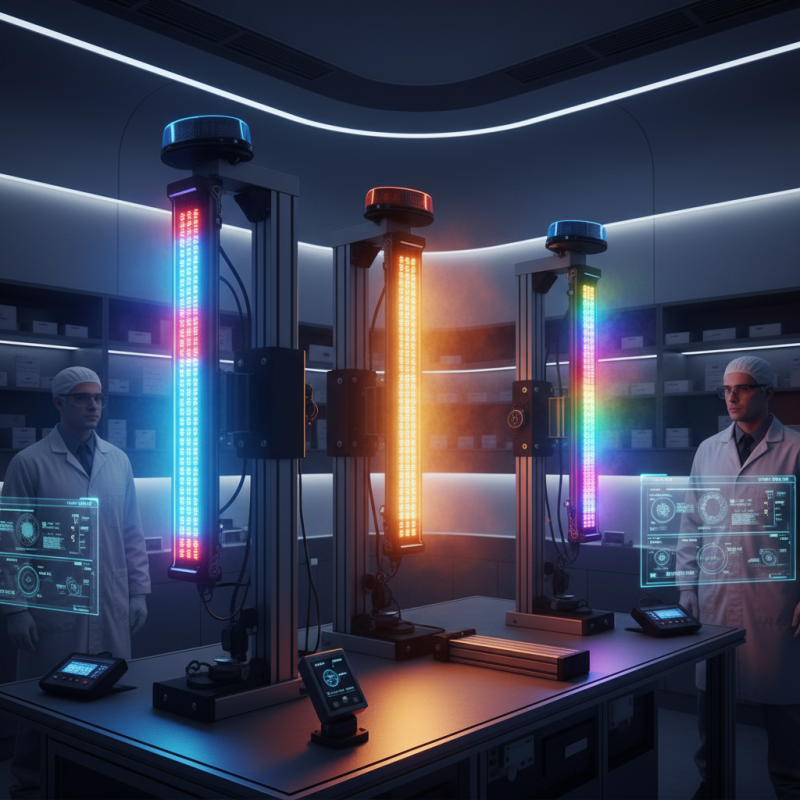
LED strobe lights are powerful tools used in various applications, from emergency vehicles to theatrical productions. Understanding their basic functions helps you choose the right model for your needs. These lights emit bright, flashing beams to grab attention and signal important messages. They can enhance safety and visibility in low-light conditions.
The brightness of LED strobe lights is measured in lumens. A typical strobe light can produce anywhere from 100 to 3000 lumens. Research indicates that higher lumens result in better visibility during emergencies. However, consider your situation. A light that is too bright may cause disorientation, while too dim may not serve its purpose.
**Tips**: Look for strobe lights with adjustable brightness settings. This feature allows you to customize the intensity. Also, consider the flash rate. A faster rate can be more attention-grabbing but may be overwhelming.
When selecting a strobe light, think about the environment it will be used in. Waterproof models are suitable for outdoor settings. Strobe lights powered by rechargeable batteries offer versatility for different situations. However, some users find that battery life falls short during prolonged use. Reflect on your specific requirements to find the best fit.
Identifying Your Specific Needs and Applications for Strobe Lights
When selecting strobe lights, identifying your specific needs is crucial. Consider the setting where you will use the lights. Outdoor environments demand weather-resistant models. Indoor usage might require less rugged options. Think about visibility too. Some environments need brighter lights for clear signaling. Others may work with softer lights that blend in better.
Application plays a key role in your choice. Emergency responders often need high-intensity strobe lights. They rely on these lights for quick visibility. Construction workers may need portable and flexible options. Think of mobility and ease of setup here. Fireworks displays could benefit from strobe lights with effects, enhancing the visual experience.
Also, reflect on the power source. Battery-operated models offer flexibility but need regular upkeep. Plug-in models may limit placement but can be more reliable. Finding the right balance is essential. Your specific needs, application, and details will guide your decision. Don't rush; sometimes, a thorough reflection leads to the best choices.
2026 How to Choose the Best Led Strobe Lights for Your Needs?
| Feature |
Description |
Best For |
Brightness (Lumens) |
Power Source |
| Flash Patterns |
Variety of strobe light patterns for different applications |
Emergency vehicles, construction sites |
1000 - 2000 |
Battery or hardwired |
| Mounting Options |
Different mounting styles like magnetic, suction cup, or permanent |
Temporary setups, vehicles |
800 - 1500 |
Battery powered |
| Durability |
Waterproof and shock-resistant designs |
Outdoor use, harsh environments |
500 - 1200 |
AC or DC |
| Color Options |
Available in different colors such as red, blue, and white |
Traffic control, emergency signaling |
600 - 1300 |
Battery or solar |
| Control Options |
Manual switches or remote control functionality |
User convenience, flexibility in operation |
700 - 1400 |
Battery or wired |
Key Features to Consider When Choosing LED Strobe Lights
When selecting LED strobe lights, it's essential to consider key features that will meet your specific needs. The brightness of the lights, measured in lumens, is a primary factor. A report by the Illuminating Engineering Society indicates that for effective visibility during emergencies, strobe lights should exceed 400 lumens. This level ensures that the lights catch attention quickly.
Another critical aspect is the flash rate. Research shows that a flash rate of 60 to 120 flashes per minute effectively draws attention. However, a higher frequency may be overwhelming. Consider the usage scenario when selecting. For instance, lights intended for outdoor use should have a weatherproof rating, such as IP65. It guarantees durability against elements, ensuring longevity.
Power source is often overlooked. Battery-operated strobe lights offer portability but might need frequent recharging. Wired options can provide consistent power but limit flexibility. Evaluating the installation space is vital here, as some setups require a more compact design. Future needs should also be addressed, as changing environments could necessitate a switch in light specifications.
LED Strobe Lights Features Comparison
Evaluating the Brightness, Color, and Patterns of Strobe Lights
When selecting LED strobe lights, brightness is a critical factor. The intensity of light determines visibility. A high lumen output can cut through darkness. However, too much brightness can be blinding. Balance is key. Consider your specific needs. For example, emergency responders may need very bright lights. On the other hand, decorative use may require softer illumination.
Color also plays a significant role. Different colors evoke various moods and reactions. Red and blue are often associated with emergency services. Meanwhile, white lights tend to provide clarity and are widely used for general purposes. Think about where and how the lights will be used. This will influence your color choice.
Tips: Consider the strobe light patterns available. Some lights offer multiple flash patterns. Slow flashes might be better for decorative purposes. Rapid flashes are more attention-grabbing. Experiment with patterns to see what fits your needs best. Reflect on how these differences affect your choice. Choosing the wrong pattern might lead to confusion or reduced effect. Always envision the end use.
Comparing Top Brands and Models of LED Strobe Lights on the Market
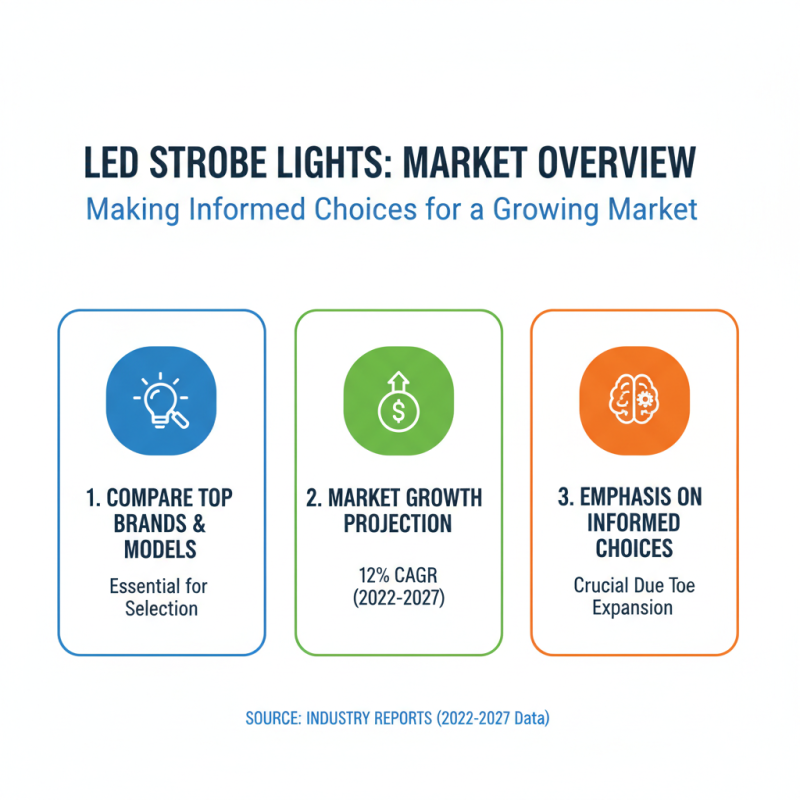
When choosing LED strobe lights, a solid comparison of top brands and models is essential. According to industry reports, the global LED strobe light market is projected to grow at a CAGR of 12% from 2022 to 2027. This significant expansion emphasizes the need for informed choices.
Key features often considered include brightness, durability, and energy efficiency. Many lights boast different lumens ratings, impacting visibility. Models with over 1500 lumens provide excellent performance for outdoor use. However, not all strobe lights meet these claims uniformly, so careful research is crucial.
Moreover, the design elements, such as size, weight, and mounting options, also play an important role. Some users prefer compact models for ease of setup. However, compactness can sometimes compromise power. A strobe light that excels in one area may fall short in another. Balancing these factors is essential for meeting specific needs.